

 Marketplace
 Jobs
Jobs Motors
 Property
 Services
 Business For Sale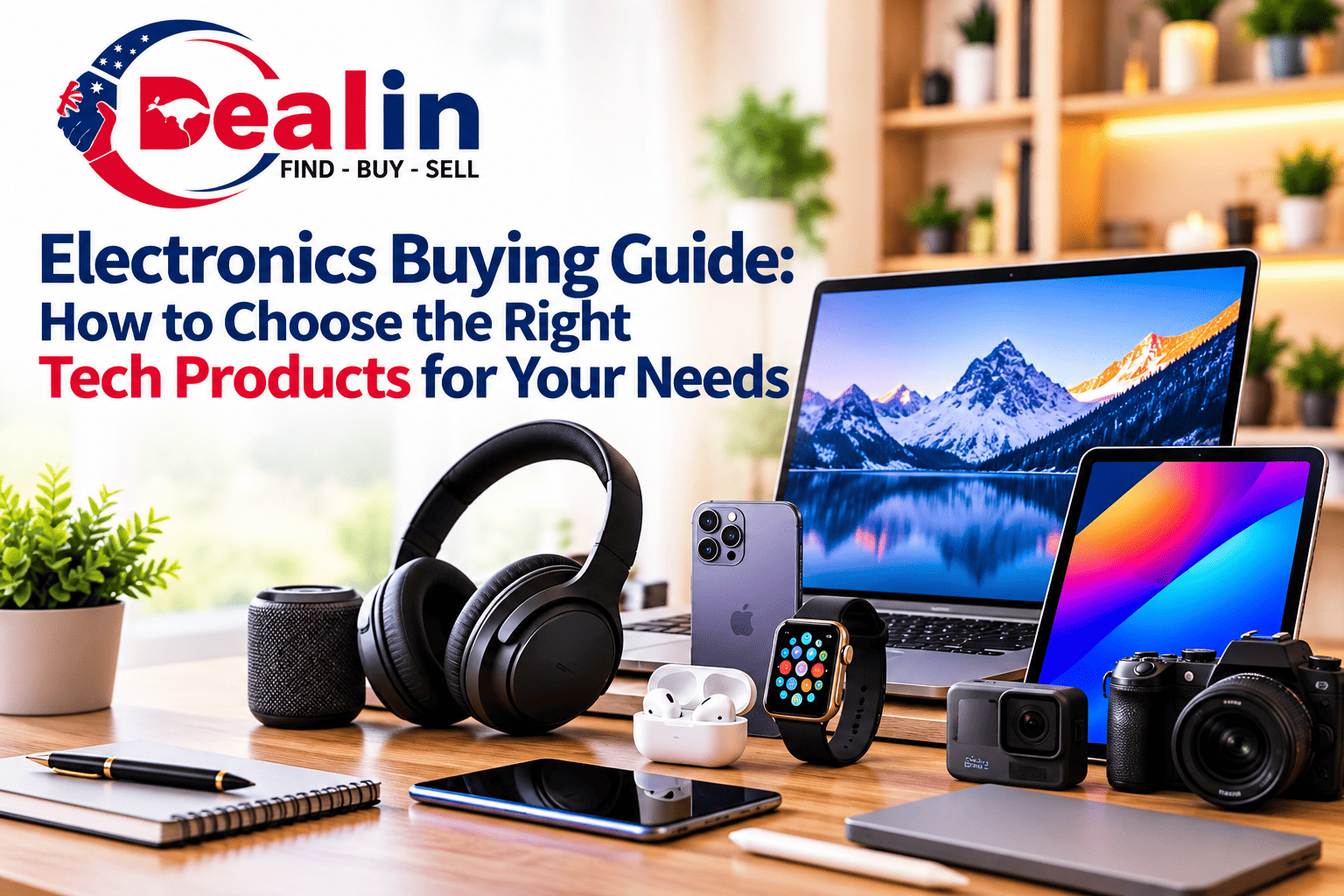




Electronics Buying Guide: How to Choose the Right Tech Products for Your Needs
No one finds it hard to find electronics nowadays. That's not the issue. The issue is that in all things it is too much, too many models, too many lists of features full of numbers that say nothing about their actual usefulness and too many "most recommended" lists that feature the same three products for any given type of usage.
Buying the right piece of tech isn't about finding the highest-rated option. It's about matching a product to your actual use case, which sounds obvious and somehow almost nobody does it properly. This guide walks through the categories people get wrong most often, cameras, audio, TVs, projectors, GPS, and general electronics and accessories, with the specific things worth actually checking before you spend money.
Cameras: Stop Buying for Specs You'll Never Use
Camera shopping is where spec-sheet obsession does the most damage. Megapixels get thrown around like they're the whole story, and honestly, past about 20 megapixels, more resolution barely matters for anyone who isn't printing billboard-sized images. What actually matters, and what almost nobody checks first, is sensor size.
A larger sensor, be it full frame or APS-C versus the tiny sensors in most compact cameras and phones, is much better at dealing with low-light situations and allows it to mimic the shallow depth-of-field aesthetic associated with many "professional" photographs. Megapixels are probably not the defining characteristic of a great camera, at least if you're choosing between phone or mirrorless: if you felt like you needed a camera because your pictures weren't turning out well on your phone, or you want that bokeh look, you should prioritize sensor size.
For those who are on the fence between getting a mirrorless camera or relying on their phone, consider what you expect to use the camera for. As of the writing of this article, a recent flagship smartphone can rival many entry-level mirrorless cameras in its everyday utility: if you're just going to use it for casual snapshots of friends and family, a phone will be more than sufficient in most lighting conditions. However, a dedicated camera will have significant advantages over a phone in capturing fast-moving subjects, so if you expect to use the camera for sports, wildlife, or children, you should consider a mirrorless option with strong autofocus and burst modes.
Lenses will provide much more value than upgrades to the camera body, and most entry-level photographers don't invest nearly enough in them. A cheap camera with nice glass will generally beat an expensive camera with cheap lenses.
Audio: The Category Where Ears Matter More Than Reviews
Audio gear is uniquely personal in a way most electronics aren't, and this is exactly why relying purely on written reviews for headphones or speakers is a mistake. Two headphones can measure similarly on paper and sound genuinely different to two different people, ear shape, hearing sensitivity, and personal taste in bass versus clarity all play a real role.
That said, a few things are worth checking regardless of taste. For headphones, actual comfort during extended wear matters more than most buyers realise until they've owned an uncomfortable pair, clamping force and ear cup material genuinely affect whether you'll want to wear something for three hours straight. For anyone buying wireless earbuds specifically, check the actual battery life including the charging case, not just the earbuds alone, and check if they support multipoint connection if you regularly switch between your phone and laptop, since not having that feature is a genuinely common source of frustration.
For speakers and home audio, room size should be the dominant consideration when choosing gear, not power output. Power output is not the enemy, but a powerful speaker in a small room can sound genuinely worse than a modest one properly matched to the space due to acoustic reflections, etc. And if you are doing it right, speaker placement and room treatment will have more impact on the sound than buying a better (but more expensive) speaker, at no cost.
TVs: Where Marketing Terms Actively Confuse Buyers
TV shopping is genuinely one of the more confusing electronics categories because manufacturers use inconsistent, often meaningless marketing terms for similar underlying technology. What actually matters, in order of importance for most buyers, is panel type, then resolution, then refresh rate, then smart TV software.
OLED panels offer genuinely superior contrast and black levels compared to standard LED or LCD panels, since each pixel produces its own light and can turn off completely for true black. This matters enormously for movies and dark scenes, less so for a TV that's mostly on in a bright room during the day. Mini-LED is a solid middle ground, better contrast than standard LED without OLED's higher price tag, and it's improved considerably in recent years.
Refresh rate matters far more for gaming than for general viewing, a 120Hz panel genuinely benefits someone gaming on a current console or PC, but makes negligible difference watching normal television or streaming content. Don't pay a premium for a higher refresh rate if gaming isn't part of your actual use case.
Room lighting should have more say on your TV purchase than you might think. A brightly lit living room will demand a higher peak brightness from your TV to overpower the ambient light and avoid washed-out colors and loss of detail, where OLED's deep blacks don't matter as much. A dark room, or one where you plan to watch at night, is where OLED's contrast becomes more valuable.
Projectors: A Genuinely Underrated Option That Comes With Real Trade-Offs
Projectors get overlooked by a lot of buyers who assume they're strictly for dedicated home theatre setups, but modern short-throw and portable projectors have genuinely opened this category up for regular living rooms.
The trade-off nobody seems to mention, ambient light is the enemy of projections, and it is the main reason why the best-looking projectors are made for watching movies in the evening. The projector which looked perfect in the pitch-black room may look dull and murky when there is any daylight in the room. You need to keep this in mind when shopping for a projector in the living room where there is plenty of natural light; make sure to pay attention to lumens and know that most of the cheap projectors are designed for evenings only.
Screen size flexibility is projection's real strength, since you're not locked into a fixed panel size the way you are with a TV. For anyone wanting a genuinely huge image, larger than most people would ever buy in a TV, without the cost of an enormous TV panel, a projector is the more realistic path.
GPS: Still Genuinely Relevant Despite Phones
It's a fair question, why buy a dedicated GPS device when every phone has navigation built in? For everyday city driving, honestly, a phone is fine. Dedicated GPS units earn their keep in specific situations phones handle poorly.
For anyone doing serious off-road or remote travel in Australia, areas with no mobile signal, a dedicated GPS unit with pre-loaded offline maps is genuinely essential, not optional, since a phone relying on data for maps becomes useless the moment you lose signal. Marine and specialised outdoor GPS units also offer ruggedised, waterproof builds that phones simply aren't designed for, and battery life on dedicated units, especially ones that run on replaceable batteries rather than needing a recharge, matters enormously on multi-day trips where charging isn't reliably available.
For regular daily driving in populated areas, save your money, your phone genuinely does this job well.
Electronics and Accessories: The Category People Underspend On
The accessories category is where people consistently cut corners in ways that end up costing more long-term. Cheap charging cables fail faster and, worse, some poorly made ones genuinely pose a safety risk with heat and charging speed inconsistencies. A quality cable and charger from a reputable brand is worth the modest extra cost, especially for anything charging an expensive device daily.
Cases and protective accessories are worth buying based on your actual habits, not a generic "best case" recommendation. If you've never cracked a screen in your life, a slim case is fine. If you've broken three phones, spend on genuine drop protection even if it's bulkier, your own track record is the best data point you have.
Bringing It All Together
The thread running through every category here is the same: figure out your actual use case before you look at a single spec sheet or review. A camera bought for low-light portraits needs a different priority list than one bought for sports. A TV for a bright living room needs different strengths than one for a dark home theatre. A GPS unit is either essential or completely unnecessary depending entirely on where you're actually driving.
Spec sheets and star ratings are a starting point, not a decision. The right electronics purchase is the one that matches what you'll genuinely do with it, not the one that wins the most awards in a category you don't actually need.
If you're ready to start comparing, browse electronics and accessories, new and second-hand, across Australia on Dealin.com.au and find the right tech for what you actually need.
FAQs
Written By
This article is by the Dealin Team — the editorial crew at Dealin, Australia's classifieds platform for buying and selling across Motors, Property, Jobs, Marketplace, Services, and Business For Sale. We write for everyday Australians navigating the classifieds space. Have a question, or would you like us to cover a specific topic? Email us at info@dealin.com.au .


