
 Marketplace
 Jobs
 Motors
 Property
 Services
 Business For Sale
Related Item



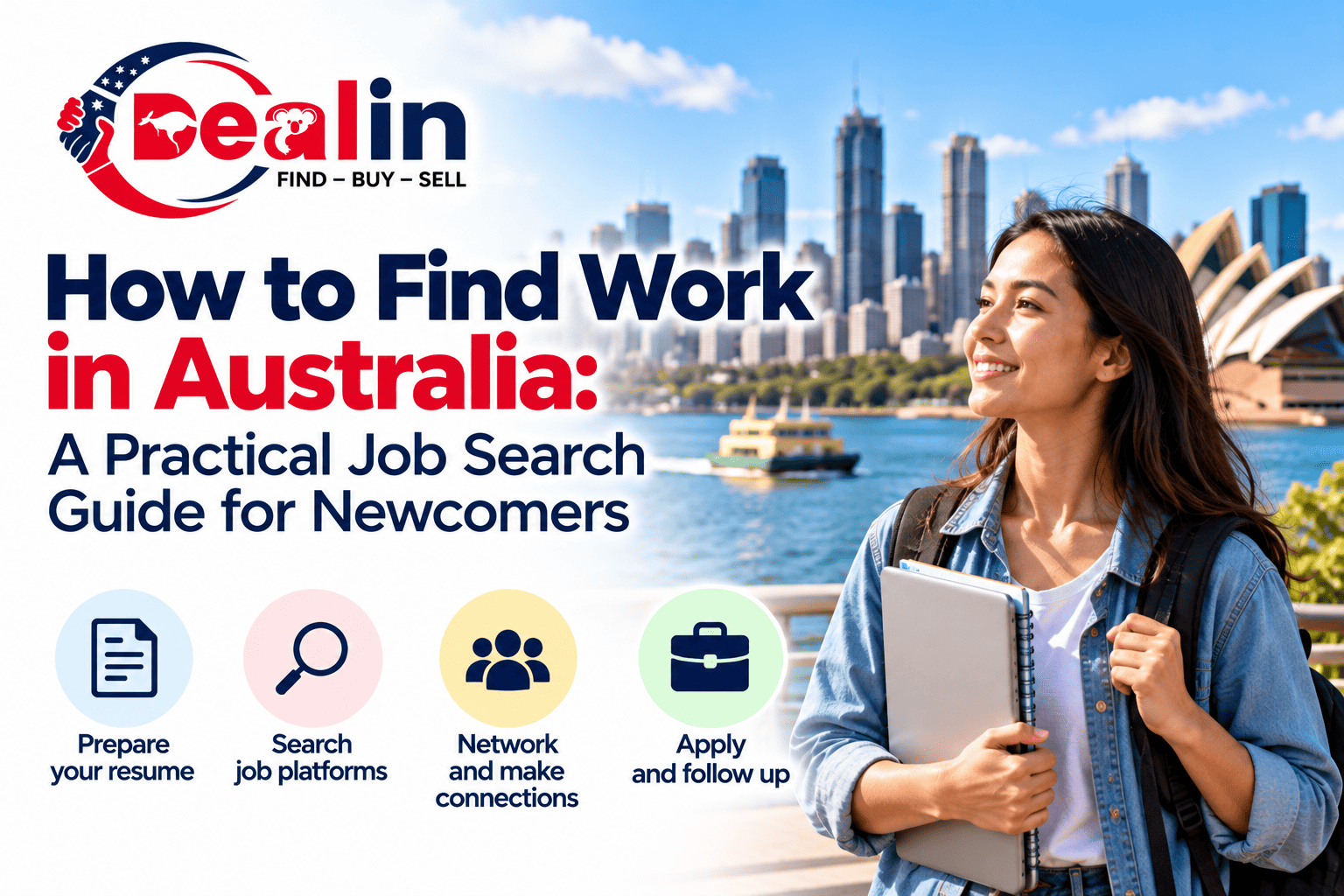
How to Find Work in Australia: A Practical Job Search Guide for Newcomers
Moving to Australia is such a huge milestone! Whether you have arrived on a skilled migrant visa or as an international student or moved here with your family for a new start, those early weeks are so exciting. But soon you will be faced with the harsh reality of paying rent, buying groceries and getting a job.
If you've already applied dozens of times without any results, take a deep breath. Often highly skilled people like engineers, accountants, nurses and experienced tradies will often fall at the last hurdle of needing 'local Australian experience'.
The great thing is that breaking into the Australian job market doesn't mean you have to forget all that knowledge and experience you've worked so hard to gain! You just need to know how to showcase your skills, understand what local companies are looking for and use the correct tools (like Dealin) to reach out to local businesses.
1. Understand How the Australian Job Market Ticks
Before you start sending out resumes to everything that comes up, take a look at where there is actual demand. The opportunities available will differ depending on which state, city and suburb you are in. Currently, the industries with high demand for reliable staff are Healthcare, Construction, Hospitality and Tourism, Trades and Services, Transport and Logistics and IT.
A common mistake people who are new to the job market make is to only look at the large corporate roles that are available in the CBD of either Sydney or Melbourne. Oftentimes there are much fewer competitors for jobs in the various business districts of the suburbs and regional areas such as Brisbane, Perth, Adelaide, Canberra, the Gold Coast, Hobart and Darwin. And employers will be quick to fill these roles so you can get in quickly.
Search for jobs using keywords and location at the same time on Dealin Jobs. For example search for warehouse assistant in Dandenong or barista in Parramatta or electrician in Brisbane. Compare different industries in your local area so you know where to put your efforts.
2. Give Your Resume an "Aussie" Makeover
Each country has its own protocol about resumes and using one from overseas will be one of the quickest methods to land in trouble with the Australian hiring managers. When preparing your CV for a position that is local, remember the following:
- Drop personal details: You don't need to include your picture, age, date of birth, marital status or religion on your resume since those things are not required for the job. Use your own name, suburb and state, Australian mobile phone number, professional email address and LinkedIn link which are essential for the purpose of the job.
- Translate your experience: If you have worked for a company that an Australian might know about then it's better to provide some context about your job (eg. "Managed logistics for a national company which has more than 80 stores"). Swap out country-specific acronyms for standard Australian industry terms.
- Keep it concise: Two to three pages are sufficient for the resume. For casual, retail, hospitality or trade roles a 1–2 page resume works best in Australia.
- Highlight results, not just duties: Instead of writing "Responsible for customer service," focus on outcomes: "Resolved over 40 customer enquiries each day with a 95% satisfaction rate."
- Customize each application: Be sure to incorporate keywords from the job posting so the employer can instantly see that you are a good fit.
3. Bridge the "Local Experience" Gap Quickly
How can you find Australian experience when no one wants to hire you without experience? The key is the practical steps you take to establish your own credibility in the area and find that long-term job.
- Consider stepping-stone roles: Working in retail, customer service, administration, warehousing or hospitality or working part-time or on a casual contract is not a step backwards. It puts Australian dollars in your pocket, introduces you to the local workplace culture and provides you with an Australian manager who can recommend your reliability.
- Get your local tickets sorted early: There are many industries in Australia that you will need certain Certifications to get started in. Whether you are in construction/trades, Hospitality, Health Care/Childcare/Support, you will need White Card, RSA (Responsible Service of Alcohol), National Police Check and Working with Children Check. Make sure to list these at the top of your resume so you stand out above those that forget to list them!
- Volunteer locally: Volunteering in your community can be a great way to practice speaking Aussie English. Even if you only have a few hours a week to spare, you'll make new contacts and will have someone who knows you locally that you can use as a reference.
4. Search Smarter and Connect Directly with Employers
When you apply on giant corporate portals your resume often lands in a pile of hundreds of applications filtered by automated software. For newcomers whose career history looks a bit different on paper, that can be a tough barrier to beat.
That is where Dealin makes a genuine difference. Built for everyday Australians and local businesses, Dealin connects job seekers directly with employers — without a middleman or recruiter's cut sitting in the way. Local business owners, from café owners in Brisbane to trade contractors in Melbourne, use Dealin to find keen workers right in their community.
To get the edge on Dealin:
- Check the Featured Jobs section: Companies that promote their jobs as featured tend to be in a rush and will be the first to hire in fast-paced industries like retail and construction.
- Watch the Latest Jobs daily: New roles across healthcare, tech and trades go live every day. Applying early before an inbox gets flooded dramatically improves your odds of getting a callback.
- Filter by work style: If you're looking for flexibility in shifts around study, casual positions or work from home opportunities, customer support or digital marketing.
5. Network the Australian Way and Nail the Interview
There are many jobs available in Australia through word-of-mouth. Networking doesn't mean being dressed up and stiff in Australia. Australians love genuine people and having a friendly conversation. You can network by joining community groups, attending local industry networking events, connecting with colleagues on LinkedIn and telling people what type of work you're looking for.
Interviews can be very informal however preparation is important. Australian employers love behaviour based questions which will often start with 'Tell me about a time when...'. Using the STAR technique (Situation, Task, Action, Result) will help you provide real examples of how you have overcome problems and worked within a variety of teams and adapted your approach in the past.
Stay safe when job searching. Never pay any fees for any job application, background checks or uniform costs when applying for an authentic Australian employer. Apply to secure job boards to keep track of your applications and remain polite. Once you're settled into your new area, finding a local job, cheap second hand furniture and reliable second hand cars can be found on dealin.com.au.
FAQs
Related Item
Written By
This article is by the Dealin Team — the editorial crew at Dealin, Australia's classifieds platform for buying and selling across Motors, Property, Jobs, Marketplace, Services, and Business For Sale. We write for everyday Australians navigating the classifieds space. Have a question, or would you like us to cover a specific topic? Email us at info@dealin.com.au .


