

 Marketplace
 Jobs
Jobs Motors
 Property
 Services
 Business For Sale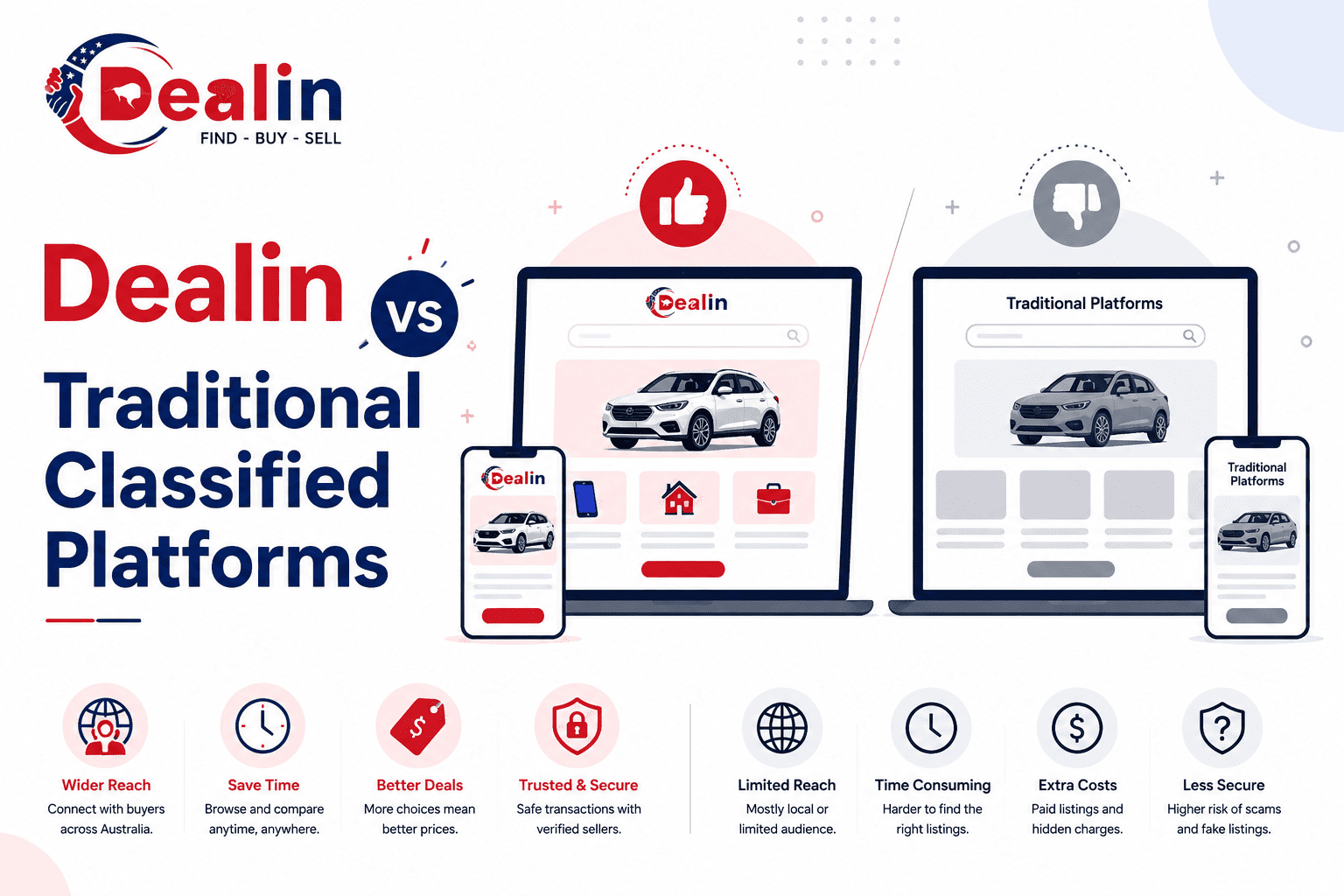



Dealin vs Traditional Classified Platforms
There's a particular kind of frustration that anyone who uses traditional print classifieds knows well. You'd circle something in the Saturday paper, call the number, get a busy signal, try again on Sunday, finally reach someone on Monday to find out the item sold Friday morning. The listing existed in a frozen moment — published once, visible for one week, with no way to update the price, add a photo, or signal that the item was still available. The seller was flying blind and so were you.
That experience wasn't unique to one city or one era. It was the standard for decades across Australia, and while it served a purpose when it was the only option available, most people who used it understood they were working within significant constraints. The question worth asking now is which of those constraints have genuinely been solved by modern digital platforms — and which ones have just been replaced by different problems.
What Traditional Classified Platforms Actually Got Wrong
The limitations of offline selling platforms were structural, not accidental. Print classifieds had a fixed publication window, zero search functionality, no photos in most cases and no direct connection mechanism between buyer and seller beyond a phone number. A buyer interested in three different couches had to make three separate phone calls, hope all three sellers were reachable and make decisions based purely on written descriptions that varied wildly in accuracy and detail.
Geographic relevance was assumed rather than designed. The paper covered a city or region, so listings were broadly local by default — but there was no way to filter by suburb, no way to search by price range, and no way to see whether a listing was still current short of calling the number. A listing that had already sold stayed in print for the remaining days of its run, generating wasted calls for both parties.
The modern vs traditional marketplaces comparison isn't just about technology. It's about what buyers and sellers actually need from a transaction platform — and how well each generation of platform has delivered it. Print classifieds delivered local reach. They delivered almost nothing else. The digital era promised to solve everything print couldn't, and largely has — but not uniformly across all platforms, and not without introducing some new friction of its own.
What Early Digital Platforms Got Right — and Where They Created New Problems
The first wave of online classified platforms in Australia — Gumtree being the most prominent — solved the obvious problems immediately. Photos. Search functionality. The ability to filter by suburb, price range, and category. Listings that stayed live until the seller removed them rather than expiring after a week regardless of whether the item had sold. Real-time updates when prices changed or items became unavailable. These were genuine, meaningful improvements over print.
The online marketplace advantages of that first digital generation were real and they drove rapid adoption. Australians moved their buying and selling online quickly because the product was genuinely better than what it replaced.
But the zero-friction listing model that made those platforms accessible created its own set of problems that compounded over time. When anyone can list anything for free with no accountability, listing quality degrades. Stale listings that were never removed. Vague descriptions that concealed significant issues. Speculative listings from sellers who weren't sure they actually wanted to sell. The volume of listings grew, the signal-to-noise ratio fell, and the time a buyer needed to invest to find a genuine, current, accurately described listing increased rather than decreased.
Social media marketplaces — Facebook Marketplace being the most significant — added another layer of complexity by embedding buying and selling into a platform designed primarily for social interaction. The reach expanded dramatically. The quality controls effectively disappeared. And the privacy implications of tying every transaction to your social identity became a concern that many Australian buyers and sellers simply hadn't anticipated.
The Digital vs Offline Selling Platforms Question in 2026
The honest comparison between digital and offline selling platforms in 2026 isn't really between digital and print — print classifieds have largely exited the picture. The meaningful comparison is between different generations and models of digital platforms, and what each one optimises for.
The platforms that have aged least well are the ones that prioritised volume over quality — enormous listing databases with degraded average listing quality and buyer experiences that require significant time investment to navigate productively. The platforms that have aged best are the ones designed for transaction quality rather than just listing quantity: structured categories that guide sellers toward providing relevant information, economic models that create a natural filter of serious intent, and geographic relevance that delivers local results to local buyers without algorithmic interference.
That design philosophy — quality over quantity, local relevance over national reach, transaction completion over engagement metrics — is what separates the platforms worth using in 2026 from the ones that have become more effort than they're worth.
Why Dealin Represents a Genuine Evolution in the Classifieds Model
Dealin was built with a clear understanding of what both traditional classified platforms and the first generation of digital platforms got wrong — and the design decisions reflect that understanding in ways that are practically meaningful rather than just cosmetically different.
The category structure is the first thing that distinguishes Dealin from both print classifieds and generic digital feeds. Dealin covers Motors, Marketplace, Property, Jobs, Services, and Business For Sale — each with listing fields specific to that category. A Motors listing asks for make, model, year, kilometres, and condition. A Jobs listing asks for employment type, location, and role description. A Services listing specifies the suburb and service type. This isn't just organisational tidiness; it's a quality mechanism. Sellers who are guided toward providing relevant information produce better listings. Buyers who can search with meaningful filters find genuine results faster. The digital vs offline selling platforms gap closes when the digital platform actually thinks about what information a transaction requires and builds that into the listing process.
The economic model is the other meaningful distinction. Dealin operates on a flat listing fee rather than a commission on completed sales or a free-for-all that creates a junk listing environment. That flat fee — transparent, predictable, and accessible for individual sellers across all categories — acts as a natural filter without being prohibitive. Sellers who are genuinely ready to transact will comfortably pay a known, fixed cost to list. Sellers who are speculative or indifferent often won't, which raises the average quality of what remains. Check current listing fees directly on Dealin's site for the latest rates, but the structure is designed to be accessible for private individuals and small businesses rather than only for commercial operators.
The online marketplace advantages that Dealin delivers are specific rather than generic: local-first search results that surface geographically relevant listings, structured category formats that produce informative listings, and an economic model that keeps the seller pool serious and the listed prices honest. Those aren't small improvements on what came before. For categories where transaction quality matters — vehicles you need to inspect, services you need to compare at a suburb level, jobs you need to evaluate for genuine fit — they're the difference between a platform that's useful and one that generates more effort than it saves.
The modern vs traditional marketplaces comparison ultimately comes down to whether the platform serves the transaction or the platform's own growth metrics. Print classifieds served the transaction within the constraints of the medium. The best digital platforms serve the transaction with none of those constraints. The worst digital platforms sacrificed transaction quality for scale, engagement, and advertising revenue — which is a different set of constraints but a real set nonetheless.
What This Means for Buyers and Sellers in Australia Right Now
The practical implication for anyone buying or selling in Australia in 2026 is that platform choice is a decision worth making deliberately rather than by default. The biggest platform isn't automatically the best platform for a given transaction. The free platform isn't automatically the most cost-effective once you factor in the time spent filtering poor quality listings. The most familiar platform isn't automatically the most useful one if the experience has degraded significantly from what it was when the habit formed.
The evolution from print classifieds to digital platforms to structured local marketplaces represents genuine progress — but that progress isn't uniformly distributed across every platform in the digital category. Choosing where you list and where you search shapes the quality of the transaction that follows, and that choice is worth five minutes of deliberate thought rather than a reflex click on the most recognisable logo.
If you're ready to experience what a purpose-built modern marketplace actually looks like in practice, browse listings across all categories on Dealin — from motors to marketplace, jobs to services, it's built for the transaction rather than the traffic.
FAQs
Written By
This article is by the Dealin Team — the editorial crew at Dealin, Australia's classifieds platform for buying and selling across Motors, Property, Jobs, Marketplace, Services, and Business For Sale. We write for everyday Australians navigating the classifieds space. Have a question, or would you like us to cover a specific topic? Email us at info@dealin.com.au .


